
第61回人権理事会 人権主流化に関する年次ハイレベルパネルディスカッションにおける尾池厚之大使ステートメント(2026年2月23日)
令和8年2月24日
The 61st Session of the Human Rights Council
Annual high-level panel discussion on human rights mainstreaming
Statement by Ambassador OIKE Atsuyuki
The Permanent Mission of Japan in Geneva
23 February 2026
Annual high-level panel discussion on human rights mainstreaming
Statement by Ambassador OIKE Atsuyuki
The Permanent Mission of Japan in Geneva
23 February 2026
[Full version]
Thank you, Mr. Vice-President.
Japan welcomes this important discussion on the role of new and emerging digital technologies in preventing and eliminating female genital mutilation (FGM), and we thank the speakers for their insights.
Female genital mutilation is a grave violation of the human rights and dignity of women and girls. In addressing such harmful practices, it is essential to tackle gender-based violence in all its forms, including those shaped by digital environments.
Digital technologies can play a transformative role in prevention, awareness-raising, and survivor support. At the same time, the digital space also presents risks, including online harassment, privacy concerns, and unequal access to services. These challenges must be addressed to ensure the safe and inclusive use of technology for women and girls.
Japan has joined the Global Partnership for Action on Gender-Based Online Harassment and Abuse, with a view to exchanging ideas and best practices with fellow members in response to technology-facilitated gender-based violence. Through international cooperation, we also support initiatives that demonstrate the practical use of digital tools, including projects for enabling survivors to participate virtually in court proceedings and for improving access to services through mobile applications.
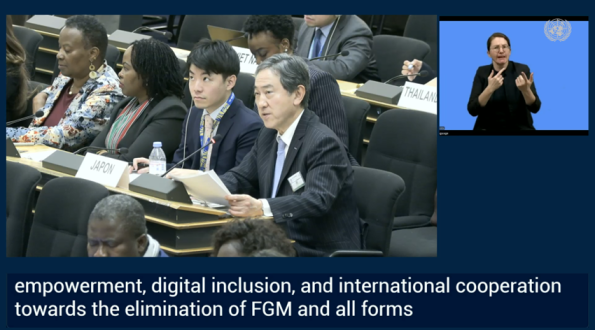
In close cooperation with all stakeholders, including civil society, Japan remains committed to promoting women’s empowerment, digital inclusion, and international cooperation toward the elimination of female genital mutilation and all forms of gender-based violence.
I thank you, Mr. Vice-President.
Japan welcomes this important discussion on the role of new and emerging digital technologies in preventing and eliminating female genital mutilation (FGM), and we thank the speakers for their insights.
Female genital mutilation is a grave violation of the human rights and dignity of women and girls. In addressing such harmful practices, it is essential to tackle gender-based violence in all its forms, including those shaped by digital environments.
Digital technologies can play a transformative role in prevention, awareness-raising, and survivor support. At the same time, the digital space also presents risks, including online harassment, privacy concerns, and unequal access to services. These challenges must be addressed to ensure the safe and inclusive use of technology for women and girls.
Japan has joined the Global Partnership for Action on Gender-Based Online Harassment and Abuse, with a view to exchanging ideas and best practices with fellow members in response to technology-facilitated gender-based violence. Through international cooperation, we also support initiatives that demonstrate the practical use of digital tools, including projects for enabling survivors to participate virtually in court proceedings and for improving access to services through mobile applications.
In close cooperation with all stakeholders, including civil society, Japan remains committed to promoting women’s empowerment, digital inclusion, and international cooperation toward the elimination of female genital mutilation and all forms of gender-based violence.
I thank you, Mr. Vice-President.